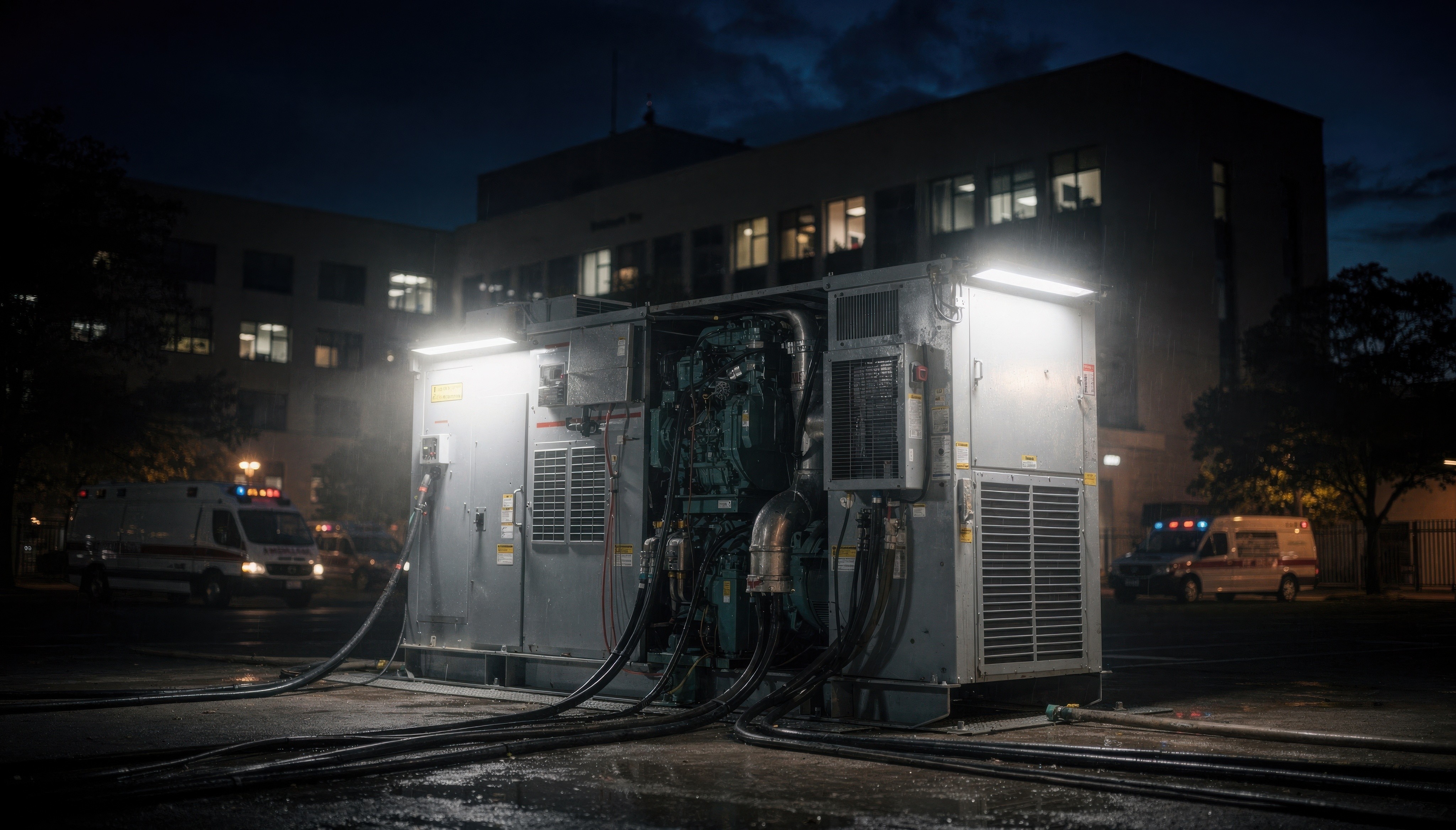
A lot of companies will sell you solar panels and battery storage. Very few will design the entire system around your site's actual load profile, and fewer still have the proprietary technology to run that system intelligently once it's built.
NextNRG does both. We design microgrids engineered to each site's specific infrastructure, energy demand, and resilience requirements, and we've built our own AI/ML technology to operate them. That combination, custom design plus proprietary control, is the core of what we do.
Every Microgrid Is Designed Around the Site It Serves
There is no one-size-fits-all microgrid. A cold storage facility runs a near-constant baseline load and can't tolerate even a short outage before product is at risk. A hospital has that same zero-tolerance for downtime, but its load spikes unpredictably with patient census and equipment use. A site with limited roof space or unfavorable solar orientation may lean almost entirely on storage and grid optimization instead of generation. None of these get the same system.
NextNRG specifies the generation mix, storage capacity, and system architecture to the site: solar or alternative generation sized to the load, battery storage sized to peak demand and outage risk, EV charging infrastructure where relevant. Nothing is sold off a shelf, because no two sites carry the same risk profile or the same cost of getting it wrong.
The Technology That Runs It: One Engine, Deployed at Every Scale
Whatever the configuration, the microgrid components must be managed intelligently once installed. That's where the proprietary technology comes in. NextNRG's AI/ML technology is the same underlying system whether it's managing a single-site microgrid or optimizing infrastructure at the utility scale. At the site level, it's deployed as the Smart Microgrid Controller. At utility scale, the same technology is deployed as the Next Utility Operating System, or UOS.
This technology continuously monitors system performance, forecasts power prices and load, and optimizes battery dispatch in real time, determining when to charge, when to discharge, and when to draw from the grid based on current conditions and what's forecast to come. RenCast, NextNRG's proprietary forecasting engine, feeds predictive weather intelligence directly into those dispatch decisions.
What makes this hard to replicate isn't just that it forecasts and dispatches, it's what it's built to handle and how it decides. The controller is energy agnostic, supporting solar, battery storage, natural gas, diesel, microturbines, and other alternative fuel-based generation on a single platform. A site's generation mix doesn't dictate a different control system, which matters because most real-world sites end up with some combination of asset types, not a single clean technology.
Dispatch decisions aren't governed by fixed rules or a static schedule either. The controller ingests real-time telemetry alongside predictive data, electricity market prices, weather, solar and load forecasts, fuel availability and pricing, and asset constraints, and re-evaluates dispatch on a rolling basis, typically every 15 minutes, with immediate response to abnormal events. Every decision balances operating cost, resilience, battery health, and site-specific priorities at once, rather than optimizing for one at the expense of the others.
That's also why the technology doesn't require a full microgrid buildout to deliver value. NextNRG deploys it as a complete, custom-engineered infrastructure solution, or as standalone technology, including cloud-based SaaS, for organizations that already operate generation and storage assets and need the intelligence layer on top.
The Dashboard: Seeing and Directing What the System Is Doing
All of this intelligence needs a way for the people running a facility to actually see it and act on it. That's what the NextNRG Dashboard is for. It's the interface that sits on top of the controller, giving operators real-time visibility into generation, storage, and grid interaction in a single view.
It also extends beyond the microgrid itself. A logistics operation running a mixed fleet, part EV, part traditional combustion, can track fuel consumption and charging activity side by side instead of juggling two separate systems. Predictive maintenance flags anomalies and routes service alerts before small issues become downtime. Carbon tracking turns generation and storage data into a reportable record of environmental impact, useful for organizations that need to show that number to a board, a regulator, or a customer.
The NextNRG Dashboard doesn't operate the microgrid. It's the visibility layer, showing what the microgrid, the controller behind it, and increasingly the rest of the operation, is doing in real time.
What NextNRG Builds
NextNRG designs custom microgrids for commercial and industrial facilities, healthcare campuses, municipal operators, tribal lands, and government sites, engineered to each site's infrastructure and operated on our own proprietary AI/ML technology from deployment.
Contact the NextNRG team at nextnrg.com to discuss what a microgrid designed for your site would look like.
This post is for informational purposes only and does not constitute financial, legal, or engineering advice. NextNRG, Inc. (NASDAQ: NXXT).
Don’t Miss Out
Join our newsletter to get latest insights for your brand growth!