For most commercial facilities, backup power is a business continuity decision. For healthcare facilities, it's a regulatory one.
A growing number of states now require healthcare facilities to maintain a minimum standard of backup power, not as best practice guidance, but as a binding condition of staying licensed and operational. Florida requires nursing homes and assisted living facilities to maintain generator power and fuel sufficient to keep safe temperatures for at least 96 hours, a standard adopted after Hurricane Irma exposed what happens when that capacity doesn't exist. California's Assembly Bill 2511 sets the same 96-hour bar for skilled nursing facilities. These aren't isolated examples. As more states examine what happened during recent hurricane seasons, similar mandates are becoming more common, not less.
The reason these regulations exist is straightforward: an extended power outage at a healthcare facility isn't an inconvenience, it's a direct threat to patient safety. Refrigerated medications and vaccines lose viability once temperatures rise. Diagnostic and monitoring equipment need clean, uninterrupted power to function correctly, not just power that eventually comes back. Scheduled procedures can't simply pause and resume once the grid is restored. That's the clinical reality the regulatory floor is built around, and it's why compliance here isn't a checkbox exercise the way it might be in other industries.
The Compliance Bar Doesn't Move for the Facilities That Have the Least
Smaller and mid-size healthcare operators, standalone nursing homes, assisted living facilities, outpatient clinics, often face the same regulatory requirements as large hospital systems without the same internal resources to plan for them. A hospital system typically has a facilities team, an engineering budget, and existing relationships with energy contractors. A standalone facility usually doesn't, and yet the 96-hour standard applies just the same.
That gap between what's required and what a facility is actually equipped to plan for is where operators get caught, not because they don't take the requirement seriously, but because building a compliant backup power system from scratch is a bigger project than it looks like on paper, and it's not something most healthcare operators have the internal expertise to design themselves.
A Generator on Paper Isn't the Same as a Generator That Works When Tested
Even for operators who do build a system, meeting the requirement isn't just about having a generator installed. It's about that system actually performing when it's needed, and that's a harder bar to clear than most facilities realize.
Healthcare facilities typically operate under standards requiring ongoing load testing and documented maintenance of emergency power systems. It's not enough to confirm the generator worked on the day it was installed, the requirement is that it keeps working, verified on a recurring schedule. A generator sized correctly five years ago may no longer cover current demand if a facility has added diagnostic equipment, expanded refrigerated storage, or changed how it operates since then. A system that hasn't been load-tested recently may fail exactly when it's needed most, quietly, with no warning until the moment the grid actually goes down.
This is the gap that catches facilities off guard: not the absence of a plan, but a plan that exists on paper without the maintenance, testing, and updated sizing to back it up.
Closing the Gap Between What's Required and What Most Facilities Have
The resource gap and the testing burden point to the same underlying problem: meeting this requirement takes more than installing a generator once and hoping it holds up when tested. It takes a system that's actually designed to perform reliably, and stays that way, over time.
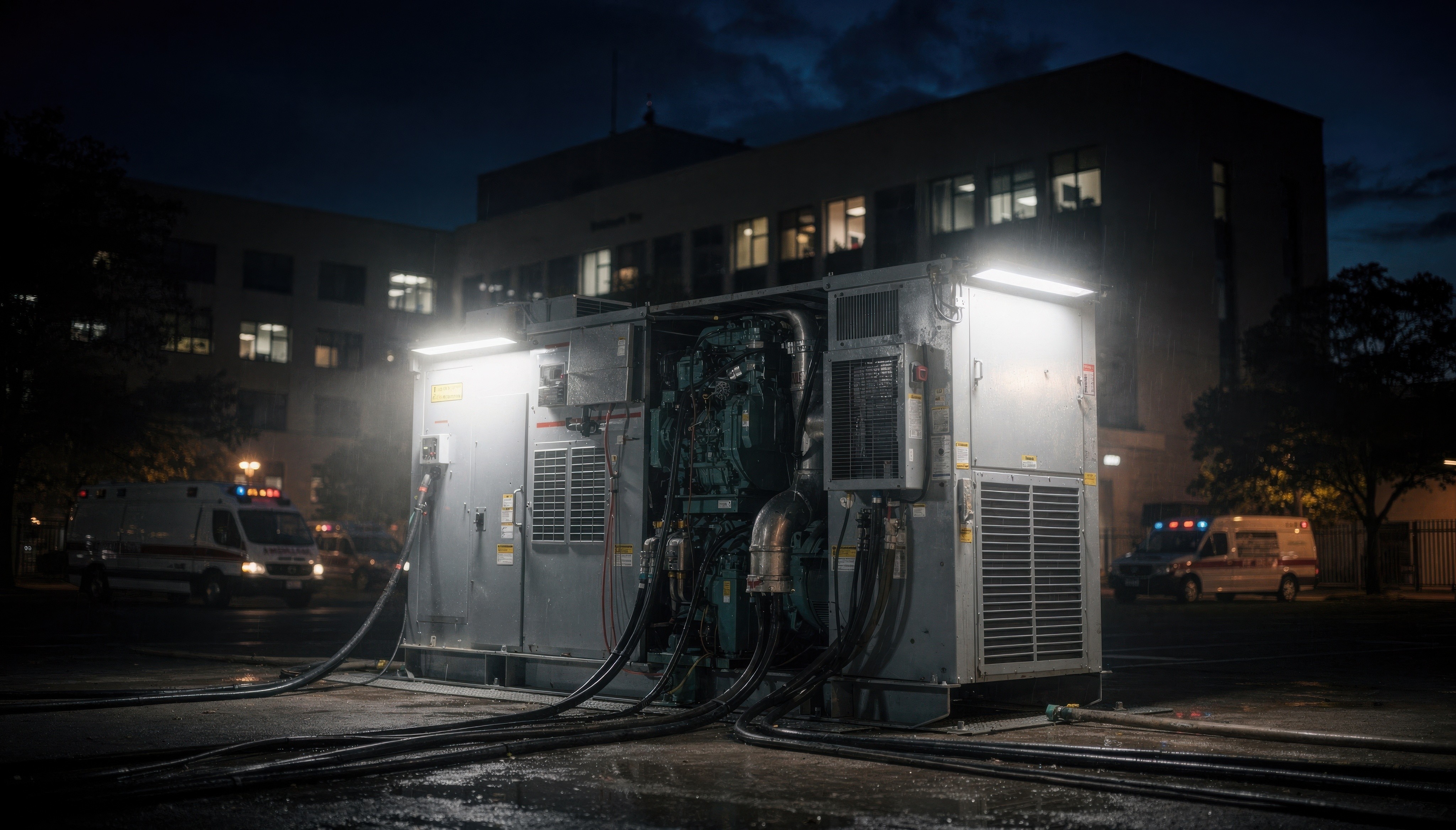
On-site generation and storage address part of this directly. A facility producing and storing its own power isn't dependent on transmission infrastructure staying intact, so it isn't exposed to the same failure points as a facility waiting for the grid to come back. But the more meaningful shift happens before conditions ever become a problem. Rather than only reacting once an outage hits, an intelligently managed system can continuously monitor conditions that signal elevated outage risk, whether that's severe weather, unusual grid strain, or another disruption, and respond in advance, drawing additional power, increasing generation, and storing that extra capacity before it's actually needed. That's the difference between a system that's ready when tested and one that's only found wanting during the event itself.
That kind of system still depends on fuel reaching the site reliably whenever a generator needs it, and fuel logistics are exactly the kind of dependency that tends to fail during widespread outage events, when demand spikes and supply doesn't keep pace. A resilient plan treats fuel delivery as dependable as the generation and storage system itself, not as a separate afterthought.
Put together, that's three components working as one coordinated system, on-site generation and storage, intelligent predictive control, and dependable fuel delivery, rather than three disconnected pieces a facility has to source and manage separately. For an operator without a dedicated engineering team, that's often the difference between a system that's technically installed and one that's actually reliable.
Why This Becomes a Portfolio Problem, Not Just a Facility Problem
That coordinated approach matters most for exactly the operators who have the least capacity to build it themselves. A single standalone facility, the kind least equipped to design a system like this from scratch, shouldn't have to solve it alone. And most don't have to, because healthcare operators rarely run a single site.
Assisted living groups, hospital systems, and outpatient networks typically operate across multiple locations, often facing the same regulatory requirement, the same clinical risk profile, and the same underlying question at every one of them: does this facility actually have the backup capacity it's required to have, or does it just have a generator that was installed once and never re-evaluated against current demand.
That repetition is actually an advantage, if it's approached the right way. A coordinated system proven at one facility becomes a template for every other facility in the same network facing the identical requirement. The regulatory standard doesn't change from one location to the next, the load profile is often similar, and the decision-makers evaluating the investment are frequently the same people across the portfolio. Operators who treat each facility as an isolated one-off decision end up solving the same problem, and the same resource gap, multiple times, at multiple costs, on multiple timelines. Operators who treat it as a portfolio-level standard solve it once and apply it everywhere else.
What This Means for Healthcare Operators Right Now
The regulatory floor for backup power is real, it's already in effect in multiple states, and a generator that isn't tested, sized correctly, or paired with a dependable fuel plan may not actually meet it. For any healthcare operator managing more than one facility, solving that gap once and applying it across a portfolio is faster and more predictable than treating every site as its own project from scratch.
What NextNRG Builds
NextNRG builds the Smart Microgrid Controller, a proprietary technology that continuously optimizes how energy is generated, stored, and consumed at a site. We deploy it with microgrid partners at commercial and industrial facilities, healthcare campuses, municipal operators, and fleet-intensive organizations, with no upfront capital required from the customer. We also sell EV chargers and operate a mobile fueling business serving fleets nationwide.
Find out whether your facility actually meets its backup power requirement, or just looks like it does. Send us your utility bills and current backup setup, and we'll show you the gap and quote what closes it. nextnrg.com
This post is for informational purposes only and does not constitute financial, legal, or engineering advice. NextNRG, Inc. (NASDAQ: NXXT).
Don’t Miss Out
Join our newsletter to get latest insights for your brand growth!