Storage is scaling fast. The market is also getting more disciplined. The question is no longer whether batteries will deploy at scale. The question is whether they will deliver full value across peak control, resilience, and grid services, and that answer depends almost entirely on how well you operate them.
The Market Signal Is Clear
Two recent data points define where the industry stands.
Reuters reported that global battery storage demand surged in 2025, driven by record solar and wind builds and growing demand for firm, dispatchable power. Average project costs late in 2025 came in around $125 per kWh, a figure that would have been considered optimistic just two years ago.
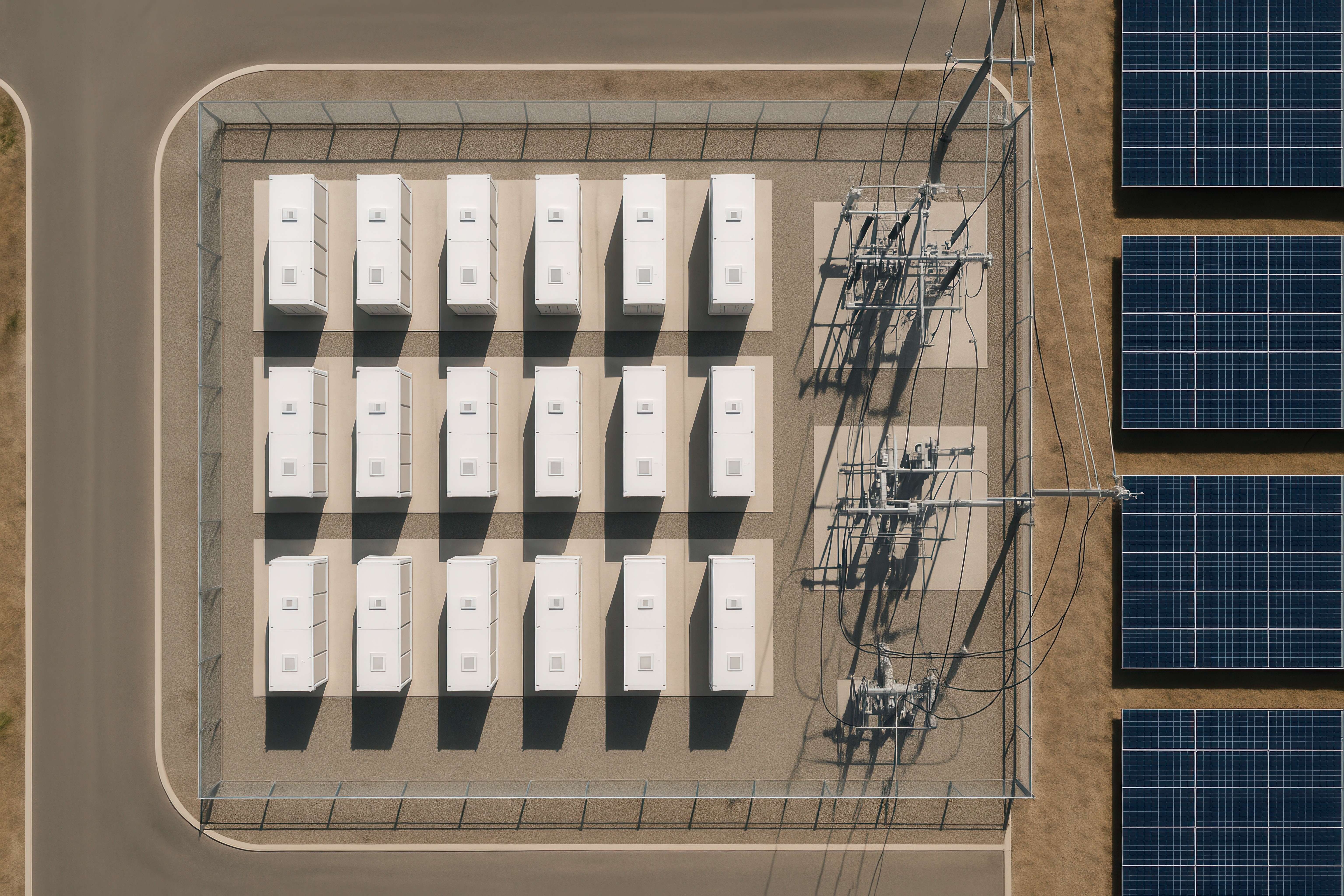
At the same time, technology continues to advance. PV Magazine reported a 200 MW, 400 MWh project entering operation using 628 Ah LFP cells, the first utility-scale deployment of that format. Larger cells mean fewer connections, lower balance-of-system costs, and better thermal performance over the life of the asset.
These two signals point to one conclusion: battery storage is becoming a standard distribution asset. Not a premium add-on. Not a pilot project. Standard infrastructure. And when something becomes standard infrastructure, the competitive advantage shifts from ownership to operation.
The Three Levers That Determine Storage Value
Falling hardware costs lower the barrier to entry. They do not automatically deliver returns. The difference between a battery system that performs and one that underperforms comes down to three operational levers.
Peak shaping. Demand charge reduction only happens if discharge aligns precisely to your true peak window. That window is often 15 to 30 minutes long. If your system is dispatching on a fixed schedule rather than responding to real load behavior, you are leaving money on the table every single month. Peak shaping requires short-interval forecasting, not guesswork.
Price alignment. Energy arbitrage: charging when prices are low, discharging when prices are high. Sounds simple. In practice it requires continuous tracking of real-time pricing signals and automated dispatch that responds faster than any human operator can. Static time-of-use blocks set at installation do not capture the actual spread between high and low price windows as markets evolve.
Lifecycle management. Battery degradation is not abstract. Every deep discharge cycle, every period of high state of charge, every thermal stress event shortens the useful life of the asset and moves up your replacement timeline. Depth of discharge rules, state of charge windows, and ramp rate controls are not optional refinements, they are the difference between a 12-year asset and an 8-year asset. That gap has significant implications for project economics and financing terms.
Why Forecasting Is Now the Core Competency
In a market where hardware costs are converging, the operator with better forecasting wins. Better forecasting means knowing when your peak will actually occur, not when it typically occurs. It means knowing how much solar generation to expect in the next four hours so you can decide whether to hold battery capacity in reserve or dispatch now. It means anticipating a demand spike from a new EV charging load before it shows up on your meter.
RenCast, NextNRG's machine learning forecasting engine, generates load and solar production forecasts at 15-minute resolution up to seven days ahead. It combines machine learning with physical photovoltaic modeling to deliver site-specific accuracy that generic weather-based forecasts cannot match. That precision feeds directly into dispatch decisions automatically, continuously, without requiring an operator to monitor a dashboard.
Tying It Together: Control, Dispatch, and Battery Health
Forecasting without automated dispatch is just information. NextNRG's intelligent microgrid controller converts RenCast forecasts into real-time dispatch decisions across solar, battery storage, and backup generation simultaneously. It enforces state of charge limits to protect battery health. It manages ramp rates to reduce stress on power electronics. It prioritizes critical loads automatically during grid events.
The result is a battery system that delivers on all three value levers: peak shaping, price alignment, and lifecycle protection, without requiring manual intervention to capture each one.
The Shift That Operators Need to Make
The industry conversation for the past several years has centered on cost reduction. That conversation is largely over. Costs have come down. LFP chemistry has won the commercial market. Project finance has matured.
The conversation that matters now is operational performance. A battery that sits at the wrong state of charge during a peak event does not reduce your demand charges. A battery that cycles too deeply does not reach its rated throughput. A battery that dispatches on a fixed schedule does not capture the full arbitrage available in a dynamic market.
Storage costs are improving. Your competitive advantage now depends on how well you operate the asset. Forecasting accuracy, dispatch automation, and battery health logic are what separate strong returns from average ones.
Market data referenced from Reuters and PV Magazine. NextNRG, Inc. (NASDAQ: NXXT) makes no guarantees regarding third-party projections or future market conditions. This post is for informational purposes only and does not constitute investment advice.
Don’t Miss Out
Join our newsletter to get latest insights for your brand growth!