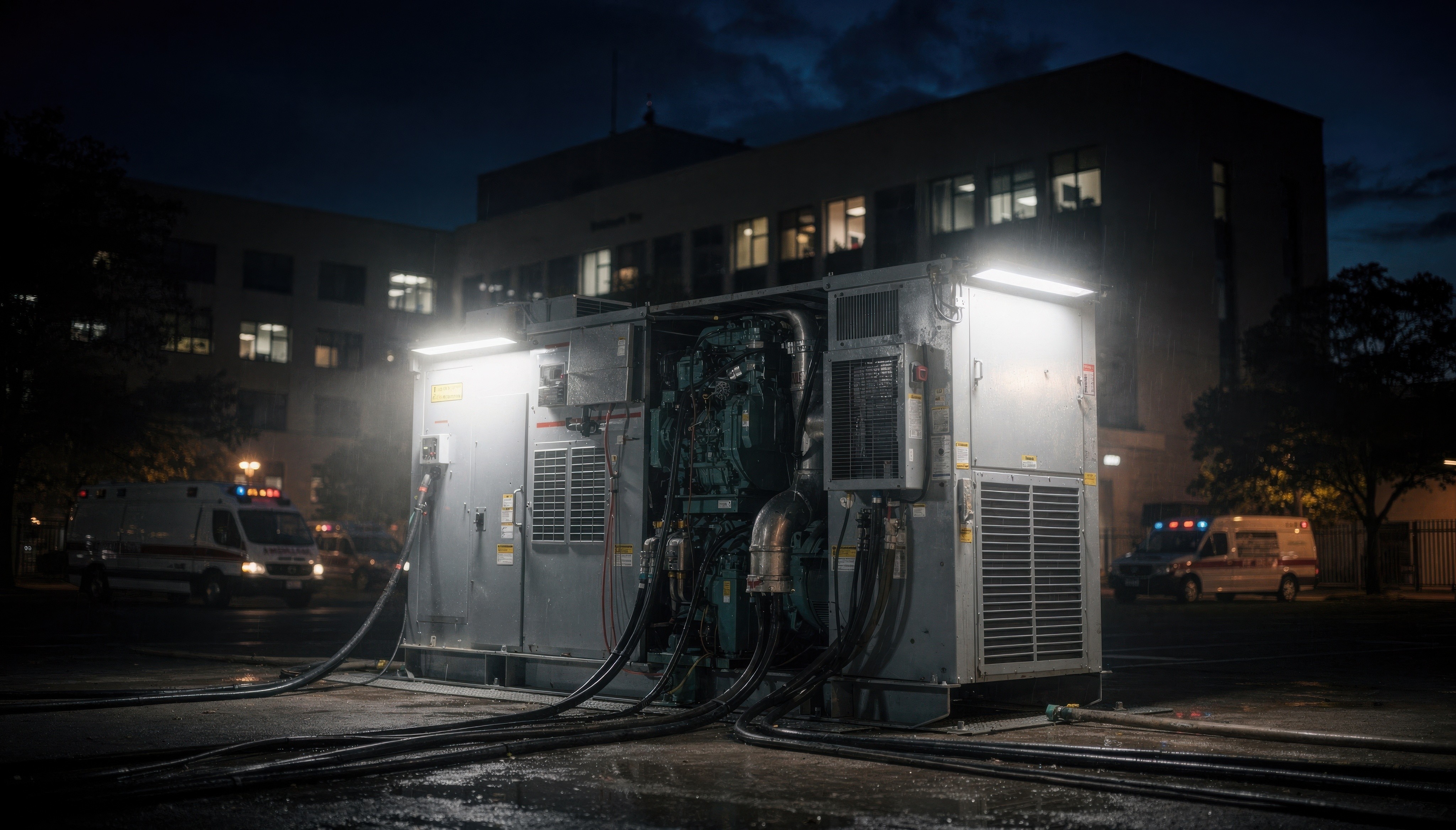
Healthcare facilities across the United States are facing a convergence of financial and regulatory pressures that are making the energy infrastructure decision significantly more urgent than it was even three years ago. Demand charges are consuming 30-70% of commercial electricity bills. Regulators in California, Florida, and a growing number of states are mandating extended backup power capability for skilled nursing and long-term care facilities. And the grid delivering that power is under more strain than at any point in recent history.
For CFOs and administrators evaluating their energy infrastructure options, the question is no longer whether to invest in resilient on-site energy systems, but rather how to structure that investment to capture the maximum financial benefit while minimizing capital exposure and operational risk.
The Regulatory Baseline Is Already Set
California Assembly Bill 2511 requires skilled nursing facilities to maintain an alternate power source capable of operating for at least 96 hours during a grid outage, effective January 1, 2024. Florida has adopted a comparable standard for long-term care facilities following Hurricane Irma, requiring nursing homes and assisted living facilities to maintain generator power and fuel sufficient to maintain safe temperatures for at least 96 hours.
These mandates are not aspirational. They are enforceable compliance requirements with real consequences for non-compliance, including potential loss of licensure and CMS Conditions of Participation violations for facilities receiving Medicare and Medicaid reimbursement.
Most facilities currently meet these requirements with diesel generators. Diesel generators satisfy the regulatory baseline but they are operationally and financially inefficient. They sit idle except during outages. They generate no economic return during the 99%+ of operating hours when the grid is functional, and they do nothing to address the ongoing energy cost burden that is affecting facility margins every month.
A solar-plus-battery microgrid with gas backup integration maintains compliance while also generating ongoing financial value.
What Demand Charges Are Actually Costing Healthcare Facilities
Demand charges are the single most underappreciated line item on a healthcare facility's electricity bill. Unlike consumption charges, which reflect how much energy you use, demand charges are billed based on your facility's highest 15-minute power draw in a given billing period. For a skilled nursing facility or assisted living campus running HVAC, medical equipment, kitchen operations, laundry, and lighting simultaneously around the clock, that peak window is set at maximum capacity and it resets every month.
Demand charges can account for 30-70% of a healthcare facility's total electricity bill depending on utility tariff structure, facility size, and operational profile. For a mid-size skilled nursing facility spending $200,000 to $400,000 per year on electricity, the demand charge component alone may represent $60,000 to $280,000 annually.
Unlike consumption, demand charges cannot be reduced through energy efficiency measures alone. A facility that cuts its overall energy use by 20% through LED lighting upgrades and HVAC optimization will see minimal reduction in demand charges if its peak demand profile remains unchanged. Addressing demand charges requires intelligent battery dispatch that anticipates and caps peak draw events before they are recorded by the utility meter.
Battery storage with AI-driven dispatch addresses this directly. A properly configured system can reduce peak demand charges by 40-60% for a typical healthcare facility, generating six-figure annual savings that compound over the life of the system.
The PPA Structure: How Healthcare Facilities Access This Without Capital Expenditure
The financing structure that makes microgrid deployment most accessible for healthcare facilities is the Power Purchase Agreement. Under a PPA, the energy developer owns, operates, and maintains the microgrid system. The healthcare facility pays a fixed rate per kilowatt-hour for the energy delivered by the system, typically structured below the current utility tariff rate and locked in for the full contract term.
For healthcare CFOs, the PPA structure has several specific financial advantages.
No upfront capital requirement. The developer funds the full cost of equipment, installation, permitting, and interconnection. The facility's capital budget is not affected. For healthcare operators managing tight margins in a reimbursement environment that does not fully account for capital investment in energy infrastructure, this is a significant practical advantage.
Predictable long-term energy costs. A 25-28 year PPA with a fixed or modestly escalating per-kilowatt-hour rate eliminates exposure to utility rate volatility over the contract term. For facilities in California and Florida where utility rates have escalated significantly over the past decade, long-term rate certainty has real balance sheet value.
Operational transfer. System maintenance, monitoring, performance guarantees, and equipment replacement over the contract life are the developer's responsibility, not the facility's. The facility receives the energy output and the cost savings without taking on the operational complexity of managing an energy system.
Off-balance-sheet treatment. Under current accounting standards, properly structured PPAs may be treated as operating expenses rather than capital leases, depending on specific contract terms and accounting treatment. Healthcare facilities should consult their accounting advisors on the specific treatment applicable to their situation.
Federal incentive capture. The developer, as system owner, captures the Investment Tax Credit and any applicable bonus adders under the Inflation Reduction Act. These incentives directly reduce the developer's cost of capital, which is reflected in the per-kilowatt-hour rate offered to the facility. Facilities accessing PPA financing benefit from the economics of the federal incentive structure without being directly eligible for it.
The Market Context: Why This Decision Is Time-Sensitive
The United States has more than 15,000 licensed nursing homes and approximately 32,000 assisted living facilities. The vast majority of these facilities rely entirely on diesel generators for backup power and have no on-site generation or battery storage.The global healthcare microgrid market was valued at approximately $3.45 billion in 2024 and is projected to reach $10.16 billion by 2033, making it one of the fastest-growing segments of the distributed energy market. Regulatory mandates tightening across multiple states and increasing grid reliability concerns are the primary drivers of that growth.
In California specifically, HCAI (Healthcare and Human Services Agency) oversight of healthcare facility construction and energy systems creates a compliance pathway that is specific to this state but increasingly being studied by other states as a model. Facilities in California that are planning solar and microgrid deployments must navigate HCAI permitting requirements in addition to standard building permits and utility interconnection, a process that adds time and requires specialized expertise.
For facilities evaluating a PPA-financed microgrid deployment, the planning and permitting timeline typically runs six to twelve months before installation begins, depending on facility type, system size, and regulatory jurisdiction. Facilities that begin the process now will be better positioned to meet tightening compliance deadlines and to capture current federal incentive structures that may evolve.
What NextNRG Builds for Healthcare Facilities
NextNRG designs, owns, and operates AI-driven microgrid systems for skilled nursing facilities, assisted living communities, and healthcare campuses under long-term Power Purchase Agreements.
Our platform integrates rooftop solar generation, battery energy storage, and gas backup integration with our Microgrid Controller and AI-driven forecasting engine. The system reduces peak demand charges through intelligent battery dispatch, maintains continuous power during grid outages through millisecond islanding capability, and supports HCAI and CMS regulatory compliance requirements for backup power capacity.
We structure projects to eliminate upfront capital requirements, transfer operational responsibility to our team, and deliver predictable energy costs over 25-28 year contract terms. For healthcare CFOs and administrators evaluating their energy infrastructure options, the financial case is compelling across multiple dimensions simultaneously: lower ongoing energy costs, regulatory compliance, operational resilience, and no capital deployment.
Contact the NextNRG team at nextnrg.com to discuss what a PPA-financed microgrid deployment looks like for your facility.
Federal and state regulatory requirements referenced in this post are accurate as of the publication date and subject to change. Financial projections and savings estimates are illustrative and based on representative facility profiles. Actual results vary by facility size, utility tariff structure, and operational profile. This post is for informational purposes only and does not constitute legal, financial, or regulatory advice. Consult qualified advisors before making energy infrastructure investment decisions. NextNRG, Inc. (NASDAQ: NXXT).
Don’t Miss Out
Join our newsletter to get latest insights for your brand growth!