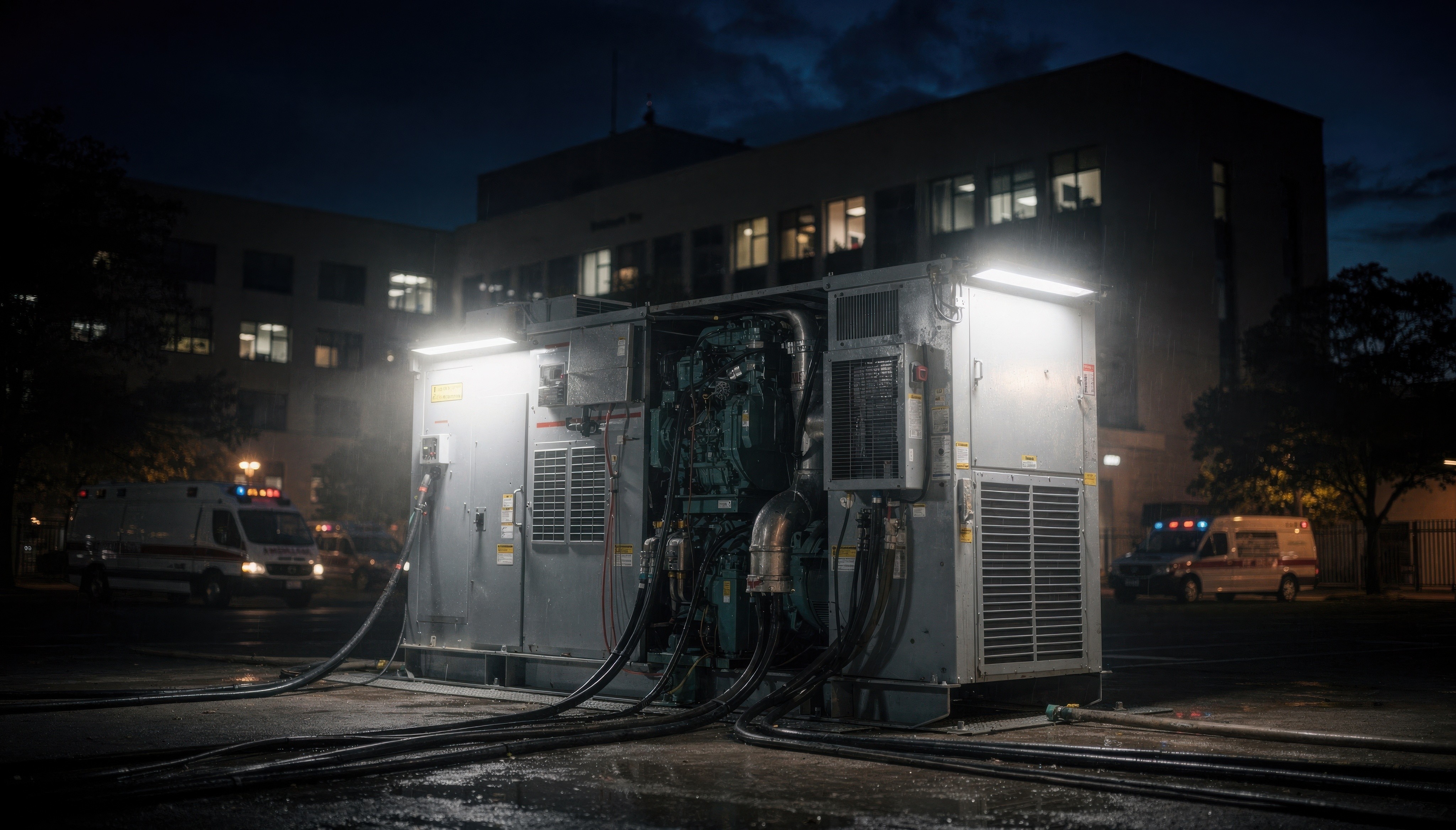
The 2026 National Electrical Code is now in effect. For operations leaders at utilities, logistics companies, and large fleet operators, this is the most significant regulatory shift in microgrid economics in over a decade. The new code removes barriers that forced engineers to choose between compliance and cost. That tradeoff is gone, and the financial implications for anyone evaluating a microgrid deployment are significant.
The global microgrid market is projected to grow from $24.4 billion in 2026 to nearly $55 billion by 2031, according to Mordor Intelligence, a 17.6% compound annual growth rate. Regulatory changes like the NEC 2026 are directly accelerating that growth by reducing project costs, shortening timelines, and making microgrid deployments simpler to permit and build.
If you operate warehouses, distribution centers, data facilities, or any asset where downtime costs real money, the NEC 2026 changes deserve your attention today.
What Changed in the 2026 NEC
Three updates in the 2026 NEC fundamentally change how microgrid projects get designed, permitted, and built.
Article 130 formalizes Power Control Systems (PCS). Previously, there was no standardized code framework for systems that actively manage electrical loads across a site. Now, PCS equipment must be listed, must prevent overload conditions automatically, and must operate in fail-safe mode. This gives engineers a clear compliance path for microgrid controllers that manage multiple energy sources, eliminating the expensive custom engineering workarounds that added months and significant cost to previous deployments.
Article 120 redesigns load calculations. Engineers can now use PCS settings to right-size electrical service. Consider a logistics campus adding 1.5 MW of EV chargers. Under the old code, that addition might trigger a full-service upgrade costing hundreds of thousands of dollars. Under the new code, a listed PCS can limit total site demand to a managed setpoint, potentially avoiding that upgrade entirely. That saves capital and eliminates six months or more of lead time on a single line item.
Article 705 clarifies distributed energy resource (DER) interconnection rules. Emergency microgrids can now operate with parallel DER sources without the compliance ambiguity that slowed previous projects. Engineers no longer have to choose between cost-effectiveness and code compliance. Combined with UL 3008 listed equipment requirements, the new code ensures safe islanded operation during outages for critical loads without requiring a code variance to get there.
Before NEC 2026, deploying a microgrid capable of islanding from the grid while running multiple generation sources typically required expensive custom engineering and often required local code variances. That process added six to twelve months to project timelines. The new code streamlines it.
What NEC 2026 Means for Microgrid Project Economics
The regulatory clarity in NEC 2026 does three concrete things to your microgrid business case.
It reduces soft costs. Standardized PCS requirements mean less custom engineering, fewer code variances, and faster permitting. Projects that previously took 18 months from design to commissioning can now move in 10 to 14 months. For a distribution center or data center operator, that timeline compression translates directly into earlier energy cost savings and faster payback.
It enables modular deployment. With clear rules for parallel DER operation, you can start with solar and battery storage, then add EV charging or backup generation later without redesigning the entire system. This phased approach lowers upfront capital requirements and accelerates time to first value. You don't need to build the full system on day one to start capturing returns.
It improves financing terms. Lenders and PPA providers price risk based on regulatory certainty. A microgrid built to a recognized national code standard is significantly easier to finance than one relying on local code interpretations or requiring variances. Lower perceived risk means lower capital costs for your project — and for operators using a Power Purchase Agreement structure, this can meaningfully improve the economics from day one.
For logistics operators, the math is clear. A single hour of downtime at a major distribution center can cost $100,000 or more. An EV fleet depot without power cannot charge vehicles. A cold storage facility without backup loses inventory. Microgrids built under NEC 2026 solve these problems while reducing long-term energy costs by 20% to 40% compared to grid-only power.
Why This Matters for Utilities
Grid operators face a growing capacity problem. AI workloads, EV charging, and broad electrification are driving unprecedented demand growth. Many grids cannot keep pace with the power density requirements of modern facilities, and the interconnection queue is not moving fast enough to close that gap.
Microgrids shift load management to the edge. The NEC 2026 makes it easier to deploy these systems at scale. With formalized PCS requirements, utilities can integrate customer-sited microgrids into their planning with greater confidence in safety and interoperability. Rather than treating distributed energy resources as complications, utilities can now position them as coordinated assets within the broader grid.
The code also supports hybrid AC/DC microgrid architectures, which are the fastest-growing segment in digital infrastructure environments. Data centers are adopting microgrids for reliability and energy independence at a pace that is reshaping utility planning. Utilities that partner with microgrid providers position themselves to serve these high-value customers rather than lose them to fully off-grid alternatives.
Why This Matters for Logistics and Fleet Operators
Distribution centers and fleet depots face a specific version of this challenge. They need reliable, large-volume power for 24/7 operations. They also need substantial electricity for EV charging infrastructure as fleets electrify. And they need it without waiting one to two years for grid interconnection upgrades that may or may not arrive on schedule.
The NEC 2026 changes this calculation directly. By allowing PCS-managed load profiles, logistics operators can deploy EV charging and on-site generation without triggering expensive grid service upgrades. A 300-acre distribution hub can install solar, battery storage, and EV charging as an integrated microgrid sized to the PCS-managed demand rather than the peak theoretical load the old code required.
This translates to faster deployment, lower capital expenditure, and greater operational uptime. The operator who electrifies first captures the cost savings first. In a sector where energy costs are a significant and growing operational line item, that first-mover advantage compounds over time.
The Market Shift Behind the Code Change
The NEC 2026 didn't emerge in a vacuum. It reflects a broader shift already underway in how the industry thinks about distributed energy.
Recent market research from leading microgrid industry surveys shows developers moving away from subsidy-dependent models and toward value-stacked projects that generate returns through multiple revenue streams simultaneously; demand response, peak shaving, resilience premiums, and carbon credits. The new code makes it structurally easier to build and finance exactly these kinds of projects.
Three forces are driving the underlying market growth: declining battery and inverter costs that continue to improve project economics year over year; advanced grid-forming technologies that enable higher renewable integration without stability tradeoffs; and regulatory frameworks, of which NEC 2026 is the most recent example, that now link grid resilience directly with financial returns.
How NextNRG Is Built for This Moment
NextNRG has been building toward this regulatory environment for years. The company's patented Smart Microgrid Controller is designed from the ground up for exactly the kind of multi-source, islanding-capable microgrid that NEC 2026 now formally supports.
The controller integrates AI-driven analytics, predictive algorithms, and real-time adaptive control logic to manage multi-source energy systems continuously. It evaluates and selects the most reliable power source, monitors equipment health and grid stability, and executes seamless transitions that prevent service interruptions. This is precisely the capability that Article 130 now formally recognizes and requires.
Underneath the controller sits HOPES (Holistic Operational Planning and Energy Solutions), NextNRG's DERMS platform for coordinating distributed energy resources within a microgrid or across a distribution network. HOPES handles the multi-DER orchestration that Article 705's clarified interconnection rules now streamline. For a logistics campus running solar, battery storage, backup generation, and EV charging simultaneously, HOPES ensures every resource operates in coordination rather than in conflict.
RenCast, NextNRG's machine learning forecasting engine, feeds the controller with predictions spanning 5-minute intervals out to 9 days ahead at approximately 93% accuracy. It forecasts power generation, demand patterns, and potential grid stress events enabling the controller to prepare for demand spikes rather than react to them.
In January 2026, NextNRG engineers published peer-reviewed research validating the technical foundations of the company's AI-driven grid intelligence platform, confirming that the performance of these systems is not theoretical but validated, published science. The company's executed long-term PPAs for healthcare microgrid deployments demonstrate the scalable financing model that NEC 2026 now makes easier to replicate across sectors.
The Window to Act Is Open
NEC 2026 has removed the regulatory friction. Battery costs continue to decline. AI-driven control systems make microgrid operations simpler, not more complex. And the financing structures, particularly PPAs, now carry lower risk premiums thanks to the code certainty the new NEC provides.
The question for operators is no longer whether the technology works or whether the economics pencil out. Both are settled. The question is whether you move at the pace the market is moving or whether you wait and close that gap later at higher cost.
Start with a site assessment. Identify your critical loads, your current energy costs, your outage exposure, and your sustainability commitments. Then model what a NEC 2026-compliant microgrid looks like for your specific situation.
NextNRG works with utilities, logistics operators, and facility owners to design, finance, and deploy microgrid solutions that deliver measurable ROI from day one.
Contact the NextNRG team at nextnrg.com or reach us at info@nextnrg.com.
This post is for informational purposes only and does not constitute investment advice. Market projections cited are from third-party sources including Mordor Intelligence and are subject to change. NextNRG, Inc. (NASDAQ: NXXT) makes no guarantees regarding future market conditions or company performance.
Don’t Miss Out
Join our newsletter to get latest insights for your brand growth!