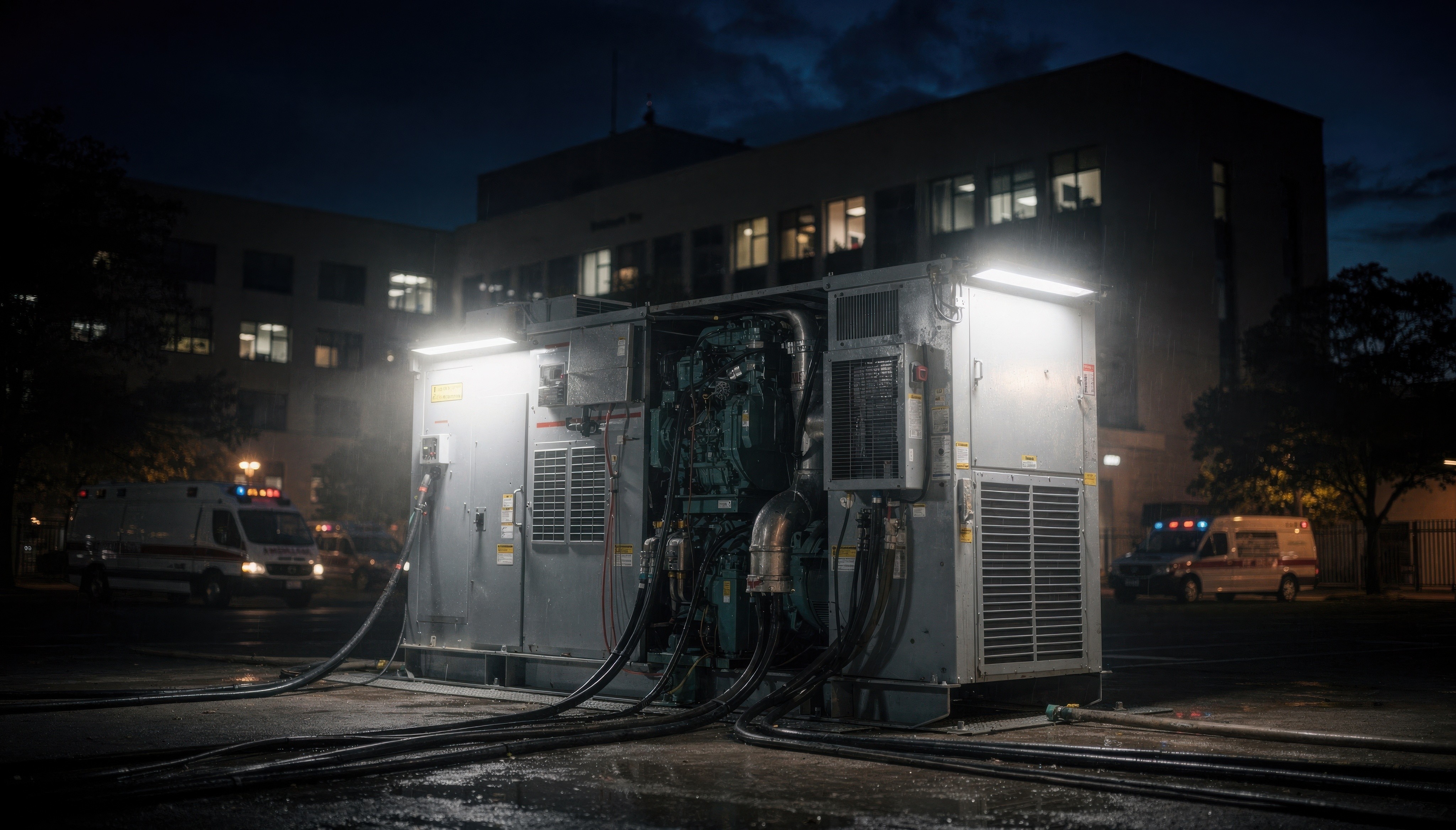
The logistics industry runs on uptime. Every hour a distribution center sits dark costs money. Spoiled inventory. Missed shipments. Broken SLAs. Customer credits. And the grid that powers these operations? It is falling further behind every year.
The American Society of Civil Engineers recently graded the U.S. power grid a D+. Over 70% of U.S. transmission infrastructure has passed the midpoint of its 50-year life expectancy. Meanwhile, electricity demand is projected to grow 25% by 2030. Actual generation increased just 2.5% last year. The gap between supply and demand is widening, and logistics facilities sit directly in its path. For warehouse operators, fleet managers, and logistics companies running 24/7 operations, this is not an abstract policy debate. It is a direct threat to your bottom line.
The Real Cost of Grid Dependence
Weather-related disasters caused more than $182 billion in damages across the U.S. in 2024. Power outages tied to extreme weather are increasing in both frequency and duration. For a cold storage warehouse or a distribution center running automated material handling equipment, even a few hours of downtime can cascade into days of recovery.
Consider the numbers. A refrigerated warehouse that loses power for four hours risks hundreds of thousands of dollars in perishable inventory. A fulfillment center processing 50,000 orders per day loses revenue with every minute offline. Fleet operators running electric forklifts and autonomous guided vehicles cannot charge during an outage, compounding the operational hit across every shift that follows.
Then there is the structural cost that rarely shows up in outage reports: peak demand charges. For many logistics facilities, demand charges account for 30% to 40% of the total electricity bill. You pay a premium rate based on your highest 15-minute consumption window in a given month, often during the exact hours your facility is running hardest. That penalty resets every month regardless of whether the grid was reliable or not. Grid dependence is no longer a calculated risk. It is a compounding liability.
Why the Grid Is Not Going to Get Better on Your Timeline
Utilities are not ignoring the problem. But the solutions they are pursuing, new transmission lines, substation upgrades, interconnection queue reforms, operate on timelines measured in years, not months. The average large-scale transmission project takes seven to ten years from planning to energization.
Meanwhile, the demand curve is not waiting. AI data centers are absorbing grid capacity at an unprecedented rate. Data centers now account for approximately 4.4% of total U.S. electricity consumption, a figure projected to reach 12% by 2030. Every megawatt that goes to a new hyperscale campus is a megawatt not available to the distribution center three miles away.
Logistics operators who are banking on grid improvements to solve their reliability problem are planning around an assumption that does not hold. The infrastructure investment needed to modernize the U.S. grid is real and ongoing, but it will not arrive fast enough to protect your operations from the next major weather event or demand surge.
Microgrids Are Moving from Optional to Essential
The microgrid market is projected to grow from $24.4 billion in 2026 to nearly $55 billion by 2031, according to Mordor Intelligence. That 17.6% compound annual growth rate reflects a simple truth: organizations across every sector are building their own energy infrastructure because waiting on the grid is no longer viable.
Data centers are leading the charge. Europe recently announced its first data center microgrid: a 110 MW privately powered campus built because grid connections could not be secured fast enough. Oak Ridge National Laboratory recently demonstrated flexible microgrid controls in Chattanooga, Tennessee, showing microgrid boundaries that can expand and contract in real time based on operational needs.
Logistics and warehouse operators face the same core problem. You need large, reliable volumes of electricity. You need it available around the clock. You cannot afford to wait years for grid upgrades. And you increasingly need to support EV charging infrastructure on top of existing operational loads, a combination that can push peak demand beyond what your current utility service can handle without expensive upgrades.
The 2026 National Electrical Code directly addresses this. New rules for Power Control Systems now allow logistics operators to deploy solar, battery storage, and EV charging as an integrated microgrid sized to a managed demand setpoint, potentially eliminating the need for costly grid service upgrades altogether.
What a Microgrid Does for Your Warehouse Operations
A properly designed microgrid integrates solar generation, battery energy storage, and backup power into a single system that can operate independently when the grid goes down. For logistics facilities, this translates to four concrete operational advantages.
Operational continuity. Your cold storage stays cold. Your automated systems keep running. Your fulfillment lines do not stop. A microgrid with battery storage provides seamless transition during grid failures, not the 30 to 45 second gap of a diesel generator startup, but a transition measured in milliseconds. Conveyor systems, sorting equipment, and temperature-controlled zones stay online without interruption.
Peak demand cost reduction. Battery storage dispatched intelligently during your highest-demand windows can reduce peak demand charges by 40% to 54%. That is a permanent, recurring reduction on your monthly utility bill, not a one-time incentive. For a facility spending $3 million or more annually on electricity, the savings are material from year one.
Energy cost arbitrage. Solar generation during daylight hours offsets the most expensive grid power. Surplus generation can be sold back to the grid during high-price periods. A well-optimized microgrid turns your roof into a revenue source rather than a liability.
Fleet electrification support. As logistics operators convert to electric forklifts, AGVs, and delivery vehicles, on-site generation and storage become essential infrastructure. A microgrid paired with EV charging gives you control over when and how your fleet charges, regardless of grid conditions or time-of-use rate structures. You charge during off-peak solar hours. You avoid the demand spikes that would otherwise blow out your monthly bill.
The Technology That Makes It Work
A microgrid is not just solar panels and batteries connected together. The value comes from the intelligence layer that coordinates all of those assets in real time.
NextNRG's AI-driven microgrid controller continuously evaluates solar output, battery state of charge, facility load, grid conditions, and energy pricing, then makes dispatch decisions automatically, every few minutes, around the clock. It does not require an energy manager watching a dashboard. It runs autonomously.
RenCast, NextNRG's machine learning forecasting platform, generates solar production and load forecasts at 15-minute resolution up to seven days out. For a warehouse managing hundreds of EV chargers alongside cold storage and conveyor systems, that forecast accuracy means the system prepares for demand spikes rather than reacting to them. It pre-charges batteries ahead of a cloud cover event. It schedules high-energy processes during peak solar hours. It aligns EV charging with the lowest-cost windows automatically.
HOPES, NextNRG's distributed energy resource management platform, provides a unified view across all assets and all buildings. For a logistics operator managing multiple facilities, HOPES enables portfolio-level optimization, coordinating energy across sites rather than managing each one in isolation.
The result is a facility that consumes less grid power, pays lower demand charges, generates some of its own revenue, and maintains operations through grid events that would otherwise cost hundreds of thousands of dollars per incident.
What the Numbers Actually Look Like
The financial case for warehouse microgrids is not theoretical. Here is what the math looks like at a representative logistics facility. A distribution center spending $3.4 million annually on electricity, with peak demand charges accounting for 38% of that bill, has roughly $1.3 million in demand charge exposure per year. A battery storage system that cuts peak demand by 50% eliminates over $600,000 in annual demand charges alone.
Add solar generation offsetting 30% to 40% of annual consumption, energy arbitrage from grid export during high-price windows, and the elimination of diesel generator fuel costs, and total annual energy cost reduction in the range of 25% to 35% is achievable, depending on facility size, location, and utility rate structure.
For a facility structured as a Power Purchase Agreement, no upfront capital is required. The facility pays a fixed per-kilowatt-hour rate for microgrid-generated power locked in below current utility tariff rates. From month one, the economics are positive.
The Window for Early Movers Is Closing
Federal funding through programs like DOE Section 40101(d) is currently available to support grid resilience infrastructure, including commercial microgrids. Declining battery costs and maturing solar technology make the economics more favorable today than they were 12 months ago. But supply chains for key components are tightening as global demand accelerates.
Operators who act now secure better pricing, faster deployment timelines, and access to incentives that will not last indefinitely. Those who wait face higher costs, longer equipment queues, and continued exposure to a grid that is not getting more reliable.
The logistics operators who electrify their facilities and their fleets first will capture cost savings first. In a sector where margins are thin and operational efficiency is the competitive differentiator, that advantage compounds over time.
Your Next Step
If you operate warehouses, distribution centers, or logistics facilities, the question is not whether microgrids make sense. It is how quickly you can get one deployed.
NextNRG designs, finances, and manages smart microgrid systems built specifically for facilities that cannot tolerate downtime. Our platform covers solar generation, battery storage, EV charging, AI-driven forecasting, and real-time optimization, all coordinated through a single intelligent control stack.
Contact the NextNRG team at nextnrg.com to schedule a site assessment and learn exactly what a smart microgrid would deliver for your operations.
Don’t Miss Out
Join our newsletter to get latest insights for your brand growth!